
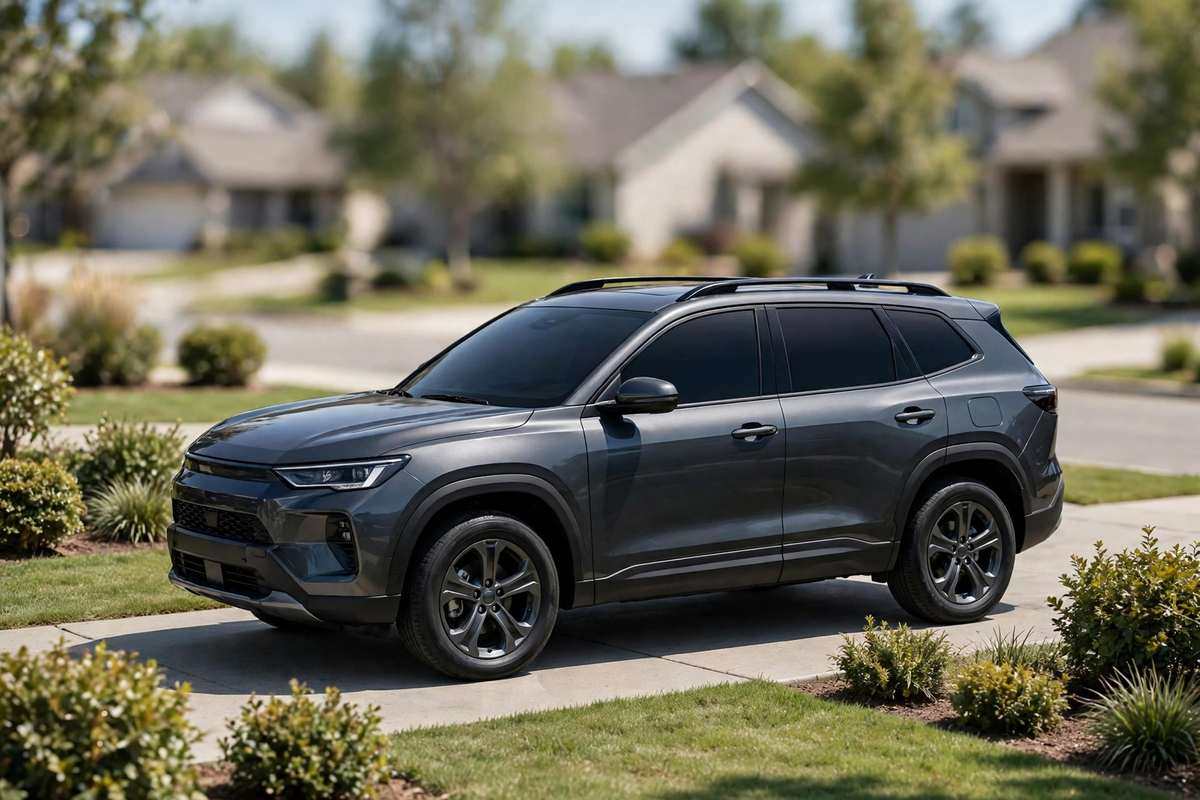
Indiana vehicle rules
IC 9-19-19-4: the figures, the four positions they apply to, the windshield rule, the medical exemption, and the penalties.
Six topics, each stated from the primary source, with the open items stated honestly alongside the settled figures. Read the state you drive in, then read the other one if you cross the river.
IC 9-19-19-4: the figures, the four positions they apply to, the windshield rule, the medical exemption, and the penalties.
KRS 189.110: the figures, the label, the tolerance, the windshield options, and the penalties.
Front windows, rear windows, windshields, labels, and medical exemptions: where the two states agree and where they do not.
What happens when an Indiana-legal car drives in Kentucky, and the front-window figure that satisfies both states.
Indiana has one; Kentucky does not. Plus the fabricated affidavit form to watch out for.
No VLT law for buildings, but historic review, sign coverage, and association questions that need asking.
Window tint law is stated in two figures: visible light transmission (VLT), the share of visible light that must pass through the glass, and reflectance, the share of light the glass may reflect. Indiana and Kentucky set different figures, apply them to different window positions, and differ on windshields, labels, tolerance, medical exemptions, and penalties. The sections below state each state's rules separately, from the statute, with the verification date and the open items shown. Nothing on this page promises, advertises, or encourages tint darker than the law allows.
Jeffersonville sits on the Ohio River across from Louisville, so drivers here live under two states' rules. Indiana and Kentucky set different figures, and the difference matters every time a car crosses a bridge. For vehicle film, see the automotive window tinting page. For homes and businesses, the building-film section below covers the separate questions. Call (812) 382-2757 during shop hours, Tuesday through Saturday, 9 AM to 5 PM, to talk through what applies to your vehicle.
Four steps, in order. The guide is research, not legal advice, and the open items are stated where they fall.
Start with where you drive
If you drive only in Indiana, the Indiana figures govern. If you cross into Kentucky, treat the Kentucky figures as governing there too — whether the rules turn on registration or operation is an open question (see Open items below) — and the stricter figure is the safe choice.
Check the position
The rules differ by window position. Front side windows, rear side windows, and windshields each have their own figure, and Indiana leaves rear side windows unlisted.
Check the exemption question
If a medical condition is part of the picture, Indiana and Kentucky answer differently. Read the medical section before assuming either way.
Call with questions
This guide is research, not legal advice. Call (812) 382-2757 during shop hours and describe your vehicle and where you drive.
The four positions
30% VLT and 25% reflectance apply to exactly four positions: the windshield, the side wings, the front-door side windows, and the rear back window. Rear side windows are not listed in the statute — although the general obstruction standard in IC 9-19-19-3 still applies to side and rear windows.
Windshield
Film is allowed only on the uppermost part of the windshield, down to the AS-1 line. No full-windshield film is allowed in Indiana.
The 'and' question
Section 4(c) joins the VLT and reflectance figures with the word 'and', which leaves room for argument about whether one figure or both must be satisfied. Compliant practice satisfies both figures. This guide states the ambiguity rather than resolving it.
Medical exemption
Yes. Documentation from an Indiana-licensed physician or optometrist, carried in the vehicle, renewed annually. There is no BMV process for the exemption.
Penalties, and what the law does not do
Penalties are civil: a driver faces a Class C infraction with a judgment of up to $500, and an installer faces a Class A infraction with a judgment of up to $10,000. The statute has no color ban, no tolerance, no label requirement, and no vehicle-class split. It was last amended in 2018.
Front and rear figures
Front side windows must allow at least 35% VLT, with reflectance of no more than 25% measured on 1/8-inch clear glass. Behind the driver, the minimum is 18% VLT, and 8% for multi-purpose vehicles (MPVs), with reflectance of no more than 35%. The term MPV is not defined in chapter 189.
Windshield
A top transparent strip outside the AS-1 area is allowed, or full-windshield film at 70% VLT or lighter that is not red or yellow. The full-windshield option is a 2024 addition, from SB 46, effective July 15, 2024.
Label, tolerance, mirrors, perforated film
A self-destructive vinyl label is mandatory, placed inside the left door jamb. A tolerance of plus or minus 3% applies. Dual mirrors are required if the rear window is nontransparent. Perforated film is covered by 30% transmittance and 35% reflectance figures with 16-section averaging and a 50% single-section cap.
Penalties and medical
An operator faces a fine of $20 to $100. An applier faces a Class B misdemeanor, up to 90 days and a fine of up to $250. There is no medical exemption. The 'TC 96-221 tint affidavit' sometimes cited online is fabricated: the real TC 96-221 is a Judiciary plates form.
01
What to ask: Front-window film at 30% VLT is lawful in Indiana but unlawful in Kentucky, where the front minimum is 35%. A film at 35% satisfies both states' front-window figures. The stricter figure governs a cross-river driver.
→ The stricter figure governs a cross-river driver.
02
What to ask: The statute joins the VLT and reflectance figures with 'and'. Whether satisfying one figure is enough is genuinely ambiguous. Compliant practice satisfies both, and this guide recommends no other reading.
→ Satisfy both figures; do not pick one.
03
What to ask: Kentucky requires the self-destructive vinyl label inside the left door jamb and allows a 3% tolerance. The MPV term, which carries the 8% figure, is not defined in chapter 189, so do not assume a vehicle qualifies.
→ The label is mandatory; the MPV question is open.
04
What to ask: Indiana allows an exemption with documentation from an Indiana-licensed physician or optometrist, carried and renewed annually. Kentucky has no medical exemption, and the affidavit form circulating online is fabricated. Confirm any Kentucky question with KYTC or KSP.
→ Indiana yes, Kentucky no, and verify any form before trusting it.
The two states side by side. Where they agree, one figure serves both; where they differ, the stricter figure governs a driver who crosses the river.
Front side windows
Indiana: 30% VLT, 25% reflectance. Kentucky: 35% VLT, 25% reflectance on 1/8-inch clear glass.
Rear side windows
Indiana: unlisted in the statute. Kentucky: 18% behind the driver, 8% for MPVs (term undefined), 35% reflectance.
Rear back window
Indiana: 30% VLT, 25% reflectance (listed). Kentucky: 18% (8% MPV), 35% reflectance, dual mirrors if nontransparent.
Windshield
Indiana: uppermost part to the AS-1 line only; no full-windshield film. Kentucky: top transparent strip outside AS-1 area, or full windshield at 70% VLT, not red or yellow.
Medical exemption
Indiana: yes, with documentation. Kentucky: none.
Label and tolerance
Indiana: neither. Kentucky: mandatory door-jamb label, 3% tolerance.
Indiana driver
Class C infraction, judgment up to $500.
Indiana installer
Class A infraction, judgment up to $10,000.
Kentucky operator
Fine of $20 to $100.
Kentucky applier
Class B misdemeanor, up to 90 days and up to $250.
This guide states what the research established and what it did not. The four items below are genuinely open, and none of them is papered over.
Open item
The Indiana figures here are drawn from research verified November 16, 2026. A direct word-for-word check of the statute text on the Indiana General Assembly site remains open.
What this means
Treat this guide as research, not legal advice, and verify against the statute text before acting on any figure.
Open item
Whether the rules turn on where a vehicle is registered or where it is operated has not been answered by the sources reviewed. The question matters most for cross-river drivers.
What this means
A cross-river driver should assume the stricter figure applies until the question is answered by an authoritative source.
Open item
The 8% figure applies to multi-purpose vehicles, but the term MPV is not defined in the chapter. Which vehicles qualify is therefore genuinely uncertain.
What this means
Do not assume a vehicle qualifies for the 8% figure. Ask, and get the answer from an authoritative source before relying on it.
Open item
The reading that Kentucky has no medical exemption should be confirmed with the Kentucky Transportation Cabinet or Kentucky State Police. The fabricated affidavit form makes independent confirmation more important, not less.
What this means
Confirm with KYTC or KSP before relying on the no-exemption reading for any specific situation.
Vehicle tint law does not apply to building glass. For homes and commercial buildings, the questions are different: historic review, sign coverage, and association rules. See the residential window tinting and commercial window tinting pages.
No VLT law for buildings
Neither Indiana nor Kentucky sets a visible-light-transmission figure for building glass. The vehicle figures on this page do not apply to homes or storefronts.
Historic review is unresolved
Whether film that changes exterior appearance needs a certificate of appropriateness in the Old Jeffersonville Historic District is an open question. Ask before work starts. Never work around review.
Sign ordinance: window coverage
Jeffersonville's sign ordinance limits window signs to 25% of window area without a permit in most districts, and 50% in some district groups — figures that matter for storefronts combining film and signage. Confirm the current ordinance text before relying on these figures.
Homeowners associations: IC 32-25.5
The Indiana Homeowners Association Act is IC 32-25.5. No HOA window-film rule has been verified for any regime in Jeffersonville. Ask the association directly; do not assume a rule exists or that none does.
Google reviews ★★★★★4.8
The Google listing shows 4.8 stars across 345 reviews. Three five-star reviews are quoted in full further down this page, exactly as Google shows them.
Five-star reviews ★★★★★322
Of the 345 reviews, 322 are five-star. The remaining 23 reviews carry the rest of the spread, and all of them count toward the 4.8 average.
All other ratings —23
Three four-star, four three-star, six two-star, and ten one-star reviews make up the remaining 23. The full spread is shown here, not just the top end.
Reviews quoted here ★★★★★3
Three five-star Google reviews appear on this page, quoted word for word with the reviewer's name and the date Google shows. No review text has been edited.
The law questions deserve a conversation, not a guess. Call Doyles Window Tinting at (812) 382-2757 during shop hours, Tuesday through Saturday, 9 AM to 5 PM, from the shop at 1107 Reeds Ln in Jeffersonville. This page is research verified November 16, 2026, not legal advice.

Three five-star Google reviews, quoted word for word. The law questions on this page are separate from the work itself; these reviews speak to the work.
“Doyle’s is the only place I take my vehicles to for tint. They do excellent work and have great prices. They stand behind their lifetime warranty no questions asked. The new ceramic tint is amazing. It keeps the inside of my vehicle’s cooler in the summer sun. The ceramic is definitely worth the extra money. If you’re looking for a trustworthy place that does excellent work then Doyle’s is the place for you.”
Michael Osborne
5 stars · 9 months ago · Google review
“This is the place to go for your tinting needs!! Everybody was super nice and very welcoming!! The tint came out perfect!! They also did the tint on my windshield! It looks amazing!! I love it!! Thanks Doyle’s for a great experience!!”
candice january
Local Guide · 5 stars · 2 months ago · Google review
“If you're looking for reliable friendly service and extraordinary quality, then you have to go to Doyle's! I've taken 4 cars to him now and every time was an amazing experience. No bubbles or light gaps like I've had in the past from another other local shop. Can't say enough good things about Doyle's Window Tinting!”
Meghan Vest
5 stars · a month ago · Google review
Plain answers, with the limits stated. This guide is research verified November 16, 2026, not legal advice. Anything about a specific vehicle is a question for the call.
The head page for vehicle film: vehicle types, coverage, and windshield questions, with the cross-river driving context that makes this law guide necessary.
View Automotive Window TintingThe middle film tier, set out honestly between dyed and ceramic. Film choice and lawful shade are separate questions; this page covers the film.
View Carbon Window TintingThe entry film tier, with the color-stability discussion stated plainly. Lawful shade is a separate question from film tier.
View Dyed Window TintingFilm for home glass, from heat and glare to fading and privacy, with the historic-home and association questions that need asking.
View Residential Window TintingFilm discussed for privacy at home and at work. Building glass has no VLT law, but review and association questions apply.
View Privacy Window FilmFilm for offices and storefronts along Jeffersonville's corridors, with the review, sign, and approval questions that belong at the start of the conversation.
View Commercial Window TintingCall (812) 382-2757 to ask about tint law questions, or to ask which film fits your vehicle within the law. The phone is the contact channel listed here. Mention where you drive, and ask about the figures that apply.
Phone
(812) 382-2757Address
1107 Reeds Ln, Jeffersonville, IN 47130
Hours
Monday: Closed
Tuesday–Saturday: 9 AM–5 PM
Sunday: Closed
Call during shop hours