
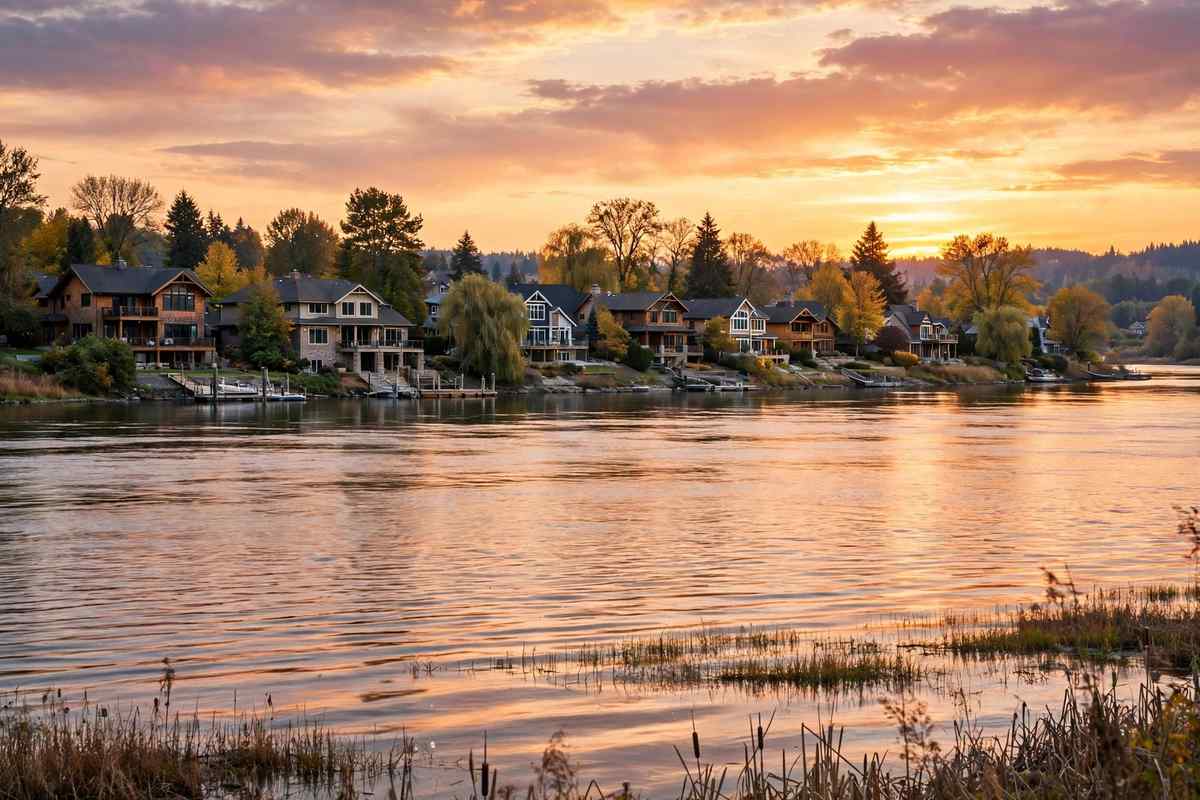
Whether you need window tint in Port Fulton depends on the house, the glass, and the direction it faces. Riverfront homes with south-facing windows face a strong combination of direct and reflected sun. This post explains why, what it means for the two listed houses and the ordinary stock around them, and what to ask before choosing film. For the area itself, see the Port Fulton page.
Why Port Fulton's riverfront location creates unusual sun exposure
Port Fulton sits on the north bank of the Ohio River, and its riverfront homes face south across the water toward Louisville. That geometry means direct southern sun plus reflected light off the river on the same glass. The research notes the river-reflection mechanism without claiming a local glare value, and this post does the same: the combination is real, and no number is attached to it.
The practical result is that river-facing rooms warm more than comparable rooms further inland, and the difference is felt most in the hot season, which runs from late May into late September in the Louisville normals. How much warmer depends on the room, the glass, the shading, and the cooling system, so no temperature figure is stated here.
Port Fulton's evidenced housing stock is narrow and specific: the Henry French House at 217 E. High Street, individually listed in 1989, and the Howard Home, now the Howard Steamboat Museum, at 1101 E. Market Street, individually listed in 1973, with stained and leaded glass windows. The age and type mix of ordinary Port Fulton houses beyond those two was not verified, and this post does not describe the stock as uniformly old or uniformly glazed. Each house is judged on its own glass.
What riverfront sun exposure means for windows in Port Fulton
Sun exposure affects windows, frames, and interiors over time, through heat cycles, ultraviolet light, and the fading of what sits near the glass. The effects are cumulative and show up in recognizable ways. Film addresses some of them and none of the others, and the distinction matters.
- Seal trouble in double-pane units. Heat cycles stress the perimeter seal of a double-pane unit. Once a seal has failed, fogging or condensation between the panes follows, and film does not fix it. A failed unit is a window question, not a film question.
- Frame and trim wear. Ultraviolet light and heat wear down finishes on the sun-facing side over time. Film reduces the light reaching the glass, but it does not restore finishes that have already worn.
- Interior fading. Hardwood floors, leather, artwork, and window treatments fade, and sunlight through glass contributes alongside other causes. Film can reduce the light reaching a room, but it cannot undo fading that has already happened.
Window film does not stop a seal that has already failed, and it does not repair glass. What it can do is reduce the solar load and light reaching the glass and the room behind it. On a riverfront home, that distinction is the starting point for an honest conversation, not a promise about the life of the glazing.
Choosing film for riverfront homes in Port Fulton, Indiana
Riverfront homes in Port Fulton usually face two wants at once: less heat and glare, and a clear river view. Film types differ in how they balance those wants, and the balance depends on the room, the glass, and whether any review or specialist question applies to the house.
Ceramic window film
Ceramic film is the premium tier in the local market, discussed for heat control with less reliance on darkness and for color stability. It contains no metal, so signal questions do not arise. For river-view glass, the question is how the film reads from inside the room: ask to see how a film looks on glass like yours before choosing. See the ceramic window tinting page.
Clear and spectrally selective film
Clearer film options suit view-facing glass where appearance matters most. What is available, and what it does, depends on the film line, and no line is named on this site. Ask the shop what clearer options exist for your glass, and read the manufacturer information for the line offered. For listed houses, the review and specialist questions come before any film choice.
What about darker dyed or metallic films?
Dyed films look dark but mostly absorb heat rather than rejecting it, and color stability over time is the honest discussion point for the entry tier. Metallic films reflect heat but raise signal questions and carry a slight mirror finish, which changes how the glass reads from the river. Both are real options; neither is the default for view-facing riverfront glass.
For the full range of residential options, see the residential window tinting page, and for the area, the Port Fulton page.
What decides the cost of window tinting in Port Fulton, IN
No prices are published on this site, and no figure is stated here. A quote for a Port Fulton home depends on the film type, the number and size of windows, the shape and condition of the glass, and whether old film has to come off first. A single river-facing window and a whole-home job are different conversations.
- Film type: ceramic sits at the premium end of the market, carbon in the middle, dyed at the entry point. Film choice is usually the largest single difference between quotes.
- Number and size of windows: more glass means more film and more work. Large river-facing panes count more than small ones.
- Glass shape and condition: curved, oversized, or damaged glass changes the fitting work. Defroster lines matter for vehicles, not homes.
- Existing film: old film that has to come off first adds removal work, and the condition of the adhesive matters.
- Access and review questions: high glass, difficult access, and any review or specialist question for a listed house all belong in the conversation before a figure is discussed.
Quotes vary with glass size, access, and prep. Describe the rooms, the windows, and the direction they face when you call, and ask what is included before comparing quotes. For vehicle quotes, see what decides a car window tinting quote.
Common mistakes to avoid with riverfront window tint
A common mistake with riverfront window tint is choosing film by darkness instead of by what it does, which leaves a homeowner with dark glass, a dim river view, and a room that still runs hot. Watch for these others:
- Ignoring the west and southwest exposures. Those panes take the afternoon sun and the reflected river load. Filming only one side leaves the worst glass bare.
- Using film meant for a different kind of glass. Vehicle film and house film are different conversations. Ask whether the film offered suits the glass it will go on.
- Assuming film stops all fading. Fading has more than one cause, and film addresses only the light reaching the room. Shading and the placement of furnishings are part of the answer too.
- Choosing film without describing the glass. Film selection should follow the glass, the direction it faces, and the room behind it, not a guess. Describe all three when you call.
- Filming glass with an existing seal failure. Film will not fix fogging between panes. A failed unit is a window question first.
Homeowners sometimes film a riverfront room and then wonder why an adjacent room still runs hot. Glass area, ceiling height, shading, and the cooling system all affect the outcome. A whole-home conversation beats a piecemeal one, even if the work is done room by room.
When to call a professional for Port Fulton window tinting
Call a professional when river-facing glass is large, when the glass is double-pane or carries a factory finish, when the house is listed or carries stained or leaded glass, or when fading, fogging, or hot rooms are already showing. Those are the situations where the film conversation needs the glass, the house, and the review questions in the same room.
Doyles Window Tinting is a window tinting service in Jeffersonville, Indiana, at 1107 Reeds Ln, open Tuesday through Saturday, 9 AM to 5 PM. Call (812) 382-2757 during open hours to talk through a Port Fulton home or vehicle, and describe the glass and the exposure when you call.
Get help with window tinting in Jeffersonville
If your Port Fulton home or vehicle faces the river sun, call Doyles Window Tinting at (812) 382-2757 during open hours and describe the glass, the direction it faces, and any listing or review question that applies. The shop is at 1107 Reeds Ln, Jeffersonville, IN 47130.