
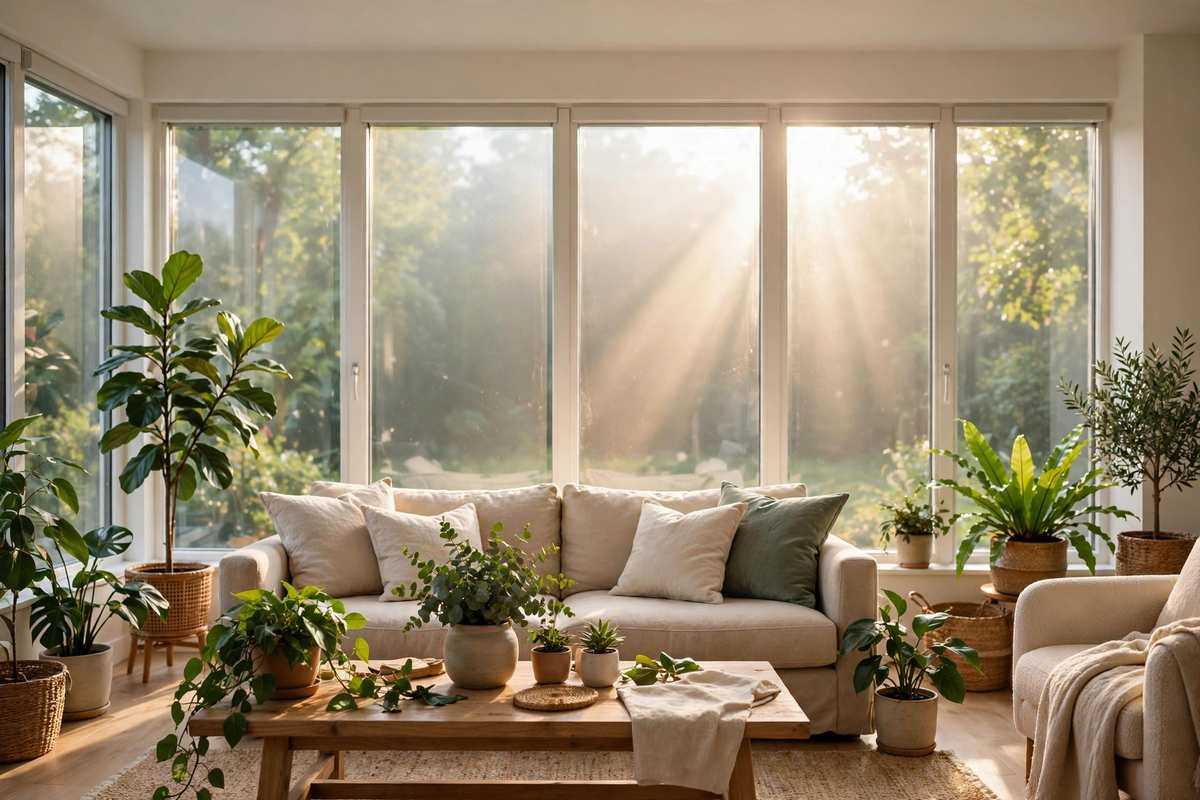
Residential window film reduces the solar heat that passes through glass into a room. That is the mechanism, and it is real. Whether a given home's cooling bills change, and by how much, depends on the cooling system, insulation, air sealing, window orientation, thermostat habits, and the rate structure, none of which film addresses. This post does not promise lower bills, because no Jeffersonville-specific savings figure was verified, and no figure of that kind is stated on this site.
Below is how film works, why savings cannot be stated as a figure, which windows matter most for comfort, and what to watch for with do-it-yourself film.
The short answer: film affects heat through glass, not bills directly
Window film usually sits on the inside of the glass and reduces the solar energy that passes through it into the room. Less solar heat through the glass means the room starts cooler and the cooling system has less solar load to remove. That is the whole mechanism, stated without figures, because how much heat a given film stops depends on the film line, and no line is named here.
A cooler room and a lower bill are different outcomes. A room can feel more comfortable while the bill barely moves, if the cooling system, the insulation, or the thermostat setting dominates the bill. Conversely, a home with large west-facing glass and an older cooling system may see more change than a home with shaded, newer windows. Both outcomes are possible, and neither is promised here.
For the full range of films discussed for homes, see the residential window tinting page. For the film types themselves, see ceramic vs. carbon window tint.
How residential window film works
Window film is a thin sheet usually applied to the inside of the glass. Depending on its construction, it reflects solar energy, absorbs heat, and reduces ultraviolet light passing through. The balance among those effects differs by film type: dyed film absorbs more than it reflects, metallic film reflects, and ceramic film is discussed for heat control with less reliance on darkness.
Two concepts come up in film discussions. The first is solar heat gain: how much solar energy passes through the glass into the room. A lower value means less solar heat passes. The second is visible light: how much light passes through. A film can reduce solar heat while keeping a room bright, or reduce both together, depending on the film. No figure is stated here for either concept, because figures belong on a manufacturer spec sheet for a named film line.
For most homes, the practical question is the trade-off between heat control and brightness. Lighter film keeps rooms brighter; darker film cuts more light. South- and west-facing rooms usually want the most heat control, and north-facing rooms usually want the least. Say which rooms matter when you call, and ask how the film reads from inside the room.
For more on film constructions, see the residential window tinting page. For heat specifically, see the ceramic window tinting page.
Why no savings figure is stated on this site
No savings figure is stated here, and no payback figure either. The reason is straightforward: no Jeffersonville-specific study of film and cooling bills was found in the research, and figures from other markets, other climates, and other housing stock do not transfer to a Jeffersonville home. A figure borrowed from elsewhere would be a guess dressed as a fact, and this site does not publish those.
The factors that decide whether bills move at all are:
- Glass area and orientation: large west- and south-facing glass admits the most solar heat. Shaded or north-facing glass admits less.
- Existing glazing: older single-pane glass and newer coated double-pane glass start from different places. Film changes each differently.
- Insulation and air sealing: heat enters through walls, roofs, and leaks as well as glass. Film addresses only the glass.
- Cooling system and habits: the system, its condition, and thermostat habits decide how much of any heat reduction shows up as a bill change.
That list is also the reason comfort, glare, and fading are often better reasons to film a room than bills. A room that is usable in late afternoon, a television that is readable, and furnishings that fade more slowly are outcomes you can feel and see. A bill change is an outcome you can only measure over time, against everything else that moves a bill.
For the variables that matter for a home, see the residential window tinting page. For the cost factors themselves, with no prices, see what decides a quote.
Which windows in your Jeffersonville home matter most
West-facing windows usually matter most. Afternoon sun strikes them during the hottest part of the day, when the cooling system is already working hardest. South-facing windows get strong sun through the day. North-facing windows get diffuse light and usually matter least for heat, though they can still matter for privacy.
If only some windows can be filmed, start with west and south. That is where solar heat gain is highest and where film changes comfort most. North-facing windows rarely need film for heat, unless privacy or glare is the reason.
Older homes in Jeffersonville carry a mix of glazing, from 19th-century sash in the historic core to picture windows in mid-century ranches. Film helps most where the glass is large, single-pane, and sun-facing, and it works alongside shading and air sealing, not instead of them. The Downtown Jeffersonville and Oak Park pages cover two of those housing eras.
Homeowners in older neighborhoods often ask about heat rejection window film because their windows are original and the afternoon sun is strong. That is exactly the setting where describing the glass, the direction it faces, and the room behind it matters most.
Choosing window film for a home in Jeffersonville, IN
For heat control, ceramic film is the premium tier in the local market, discussed for heat control with less reliance on darkness and for color stability. It contains no metal, so signal questions do not arise. It sits at the premium end of the market, so film choice is the largest single difference between quotes.
Metallic film reflects heat and sits below ceramic in the market, but it raises signal questions and carries a slight mirror finish. Dyed film is the entry tier: it absorbs heat, darkens glass, and its color stability over time is the honest discussion point. Carbon film sits in the middle, with a matte look and no metal content.
For most homes, the choice comes down to the room: how much heat control it needs, how bright it should stay, and what the glass carries already. Ask the shop to talk through the options for the specific rooms, and read the manufacturer information for the film line offered. See the ceramic window tinting and carbon window tinting pages.
If you are also thinking about your car, the automotive window tinting page covers vehicles, with the law guide for the rules that apply.
What to watch out for with DIY window film
Do-it-yourself film is tempting, and online videos make it look easy. In practice, fitting film cleanly on large or curved glass is skilled work, and the failures show up as bubbles, peeling edges, and haze. The film is rarely the only problem; fitting and prep are usually part of it.
What typically goes wrong:
- Bubbles and blisters: trapped air or moisture that does not clear. Some haze during curing is normal; persistent bubbles are a different matter.
- Peeling edges: poor adhesion from inadequate cleaning or overstretching during fitting.
- Haze and color shift: film breaking down under ultraviolet exposure, most often the entry tier.
- Glass stress: film that absorbs too much heat can stress the glass. Ask whether the film offered suits the glass it will go on, including coated and double-pane units.
Professional fitting addresses prep, environment, and film selection together. Ask what the shop puts in writing about the film and the install, and read it before booking.
When to call a professional
Call a professional when more than a couple of windows are involved, when windows are large or high up, when the glass is old or carries a factory finish, or when you are unsure which film matches the glass. Describe the rooms, the glass, and the direction each window faces when you call.
Doyles Window Tinting is a window tinting service in Jeffersonville, Indiana, at 1107 Reeds Ln, open Tuesday through Saturday, 9 AM to 5 PM. Call (812) 382-2757 during open hours to talk through your home's windows and what film can and cannot do for them.
Get help with window tinting in Jeffersonville
Call Doyles Window Tinting at (812) 382-2757 during open hours and describe your windows, the rooms behind them, and what problem you are trying to solve. The shop can talk through what film can and cannot do for your home, without promising a bill change.